
8080.ai Review: Pricing, Features, Benefits and How It Automates Software Development
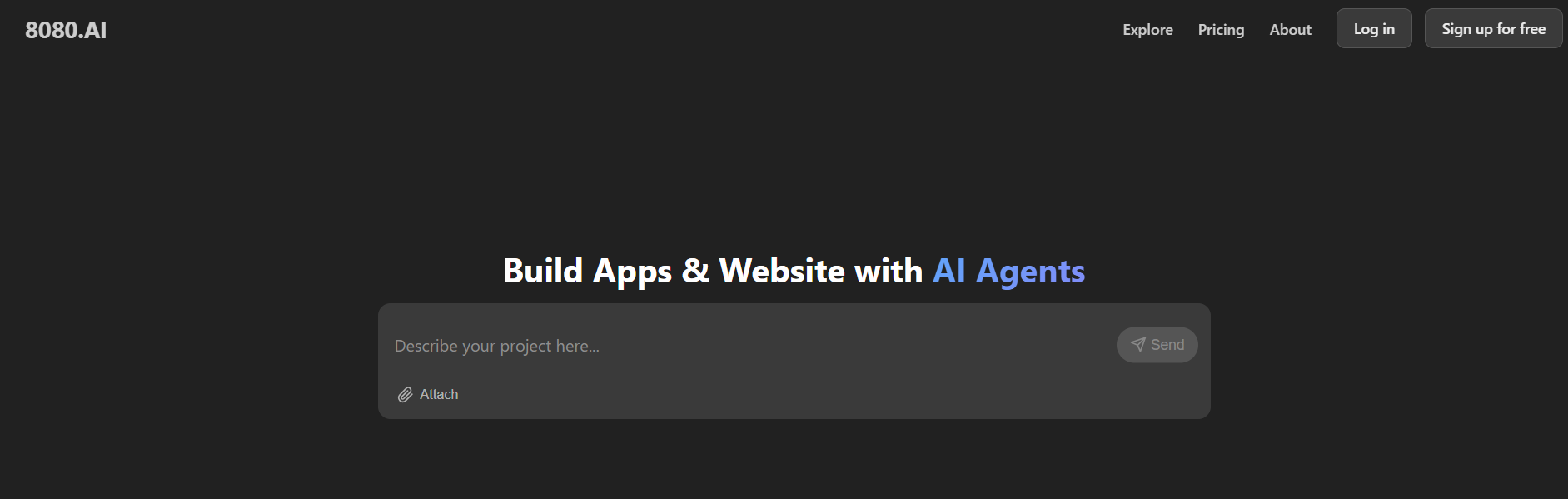
8080.ai is a modern AI software engineering platform designed to automate the complete development lifecycle. From planning and system design to coding, testing, and deployment, the platform enables users to build production-ready applications with minimal manual effort.
What makes 8080.ai distinct is its multi-agent architecture. Instead of relying on a single AI model, it uses a coordinated system of specialized agents such as frontend, backend, DevOps, and QA. These agents collaborate in parallel, similar to a real engineering team, enabling faster and more efficient software delivery.
The platform focuses on autonomy, scalability, and speed, making it particularly useful for teams looking to accelerate product development without expanding engineering resources.
Key Features
Multi-Agent AI Architecture
8080.ai uses multiple specialized agents that handle different parts of the development process. This structure allows tasks to be distributed and executed simultaneously, improving efficiency and output quality.
End-to-End Automation
The platform automates the full software lifecycle, including planning, architecture design, coding, testing, and deployment. This reduces the need for manual intervention across different stages.
Full Codebase Generation
Users can generate complete applications that include APIs, databases, authentication systems, and backend logic. This goes beyond simple code snippets and delivers production-ready systems.
Parallel Execution
Multiple agents work simultaneously on different parts of a project, significantly reducing development time compared to traditional workflows.
Browser-Based IDE
A built-in development environment allows users to view, edit, and manage code directly within the platform, making it easier to monitor progress and make adjustments.
Automated Testing and QA
Integrated testing tools ensure code quality by identifying issues early and reducing the need for manual testing processes.
Primary Use Cases
Full-Stack Application Development
Build complete applications from simple prompts, including frontend, backend, and infrastructure components.
MVP and SaaS Development
Quickly develop and launch minimum viable products or SaaS platforms with reduced development cycles.
DevOps Automation
Automate infrastructure setup, CI/CD pipelines, and deployment processes without requiring extensive DevOps expertise.
AI-Driven Testing and QA
Improve code reliability through automated testing and quality assurance workflows.
Microservices and Scalable Systems
Design and deploy scalable architectures using microservices and containerized environments.
Who Should Use 8080.ai
8080.ai is suitable for:
Startup founders looking to build products quickly
Product managers who want to prototype and iterate faster
Software engineers aiming to automate repetitive tasks
Indie hackers building projects independently
CTOs optimizing development efficiency
Non-technical entrepreneurs entering software development
Benefits
Faster Development
Parallel execution and automation reduce the time required to build and deploy applications.
Reduced Engineering Costs
By automating multiple roles within the development lifecycle, the platform minimizes the need for large teams.
Production-Ready Output
The platform generates deployable applications rather than basic prototypes, making it suitable for real-world use.
Scalability
Supports modern cloud-native architectures and microservices, allowing applications to scale efficiently.
Accessibility
Non-technical users can create applications using prompts, lowering the barrier to entry for software development.
Limitations
Pricing is not publicly available
Requires some level of oversight for complex or mission-critical systems
Learning curve for understanding multi-agent workflows
Limited transparency about underlying AI models
Pricing
Pricing Model: Custom pricing
8080.ai does not provide fixed pricing tiers. Costs depend on several factors, including project complexity, usage requirements, and infrastructure needs.
Users need to contact the company or book a demo to receive a tailored quote.
Technical Specifications
AI Models: Proprietary multi-agent system
Deployment: Cloud-based
IDE: Browser-based
Supported Languages: English
Ratings and Reviews
Current Rating: 0.0
User Reviews: No reviews available yet
As a relatively new platform, public feedback is still limited.
Alternatives
Some alternatives to consider include:
Qodo
DevSecCops.ai
Zipy.ai
Mem0
FAQs
What is 8080.ai
8080.ai is a multi-agent AI platform that automates the entire software development lifecycle, including planning, coding, testing, and deployment.
How is 8080.ai different from other AI coding tools
It uses multiple specialized agents that collaborate like a real engineering team, rather than relying on a single AI model.
Can it build complete applications
Yes, it generates full production-ready applications including backend systems, frontend interfaces, and infrastructure.
Is it suitable for non-developers
Yes, non-technical users can build applications using prompts and automated workflows.
Does it support DevOps automation
Yes, it includes features for CI/CD pipeline creation and infrastructure automation.
Is pricing publicly available
No, pricing is custom and requires contacting the company.
Conclusion
8080.ai represents a shift from simple AI coding assistants to fully autonomous software engineering platforms. Its multi-agent architecture, ability to execute tasks in parallel, and focus on production-ready outputs make it a strong solution for modern development needs.
While the lack of transparent pricing and potential learning curve may be considerations, the platform offers significant advantages in speed, scalability, and automation.
Also Read -
Best AI Tools for Call Centers to Automate Support & Boost Efficiency
Top 10 AI Tools for Drafting to Write Faster & Smarter (2026)
Top 10 AI Tools for Customer Success to Boost Retention & Growth (2026)